
Make.com Review for Small Businesses: Powerful Visual AI Automation at a Price That Actually Makes Sense (2026)
Make.com connects 3,000+ apps with a visual workflow builder and generous operation limits. Here's the honest 2026 breakdown for small businesses, including the one pricing trap to avoid before you build anything.
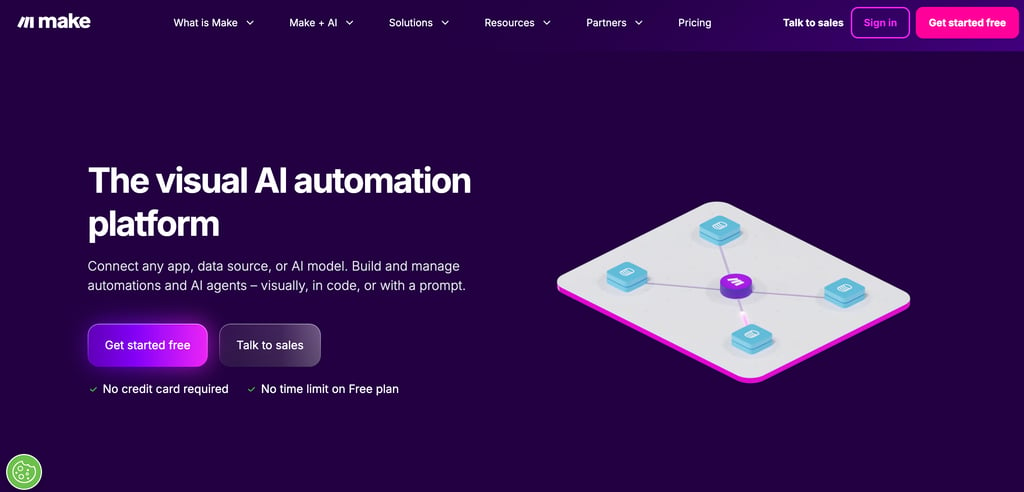

If you run a small business and spend more time than you should on repetitive digital tasks copying data between apps, chasing follow-ups manually, and updating spreadsheets by hand, automation is the fix. The question is which platform is worth your time to learn.
Make.com has become one of the most recommended automation platforms for small businesses in 2026, and for good reason: it combines a visual workflow builder, 3,000+ app integrations, and pricing that keeps costs predictable as your automations grow. The Core plan gives you 10,000 operations for $10.59/month, enough to run a meaningful set of business workflows without constantly watching the meter.
That said, there's one pricing mechanic worth understanding before you build anything. Here's the full picture.
What Make.com Actually Does
Make.com is a visual automation platform where you build workflows on a canvas by connecting modules rather than filling out a linear step-by-step form. Each module represents an app or action; you drag them onto the canvas and connect them with lines to define how data flows between them.
For a small business owner, that visual approach matters for a practical reason: when something breaks or needs updating, you can see exactly where the problem is at a glance rather than scrolling through a long list of steps to find what went wrong.
The platform connects 3,000+ apps covering every mainstream business tool: Google Workspace, Microsoft 365, Slack, Notion, Airtable, Shopify, HubSpot, Salesforce, Stripe, and hundreds more. For most small businesses, everything you use is already there.
What Small Businesses Use It For
A few common workflows that show the practical value:
Lead capture and CRM routing: A new form submission triggers a scenario that checks the lead against your CRM, creates a contact if they're new, assigns them to the right person based on territory or product interest, sends a personalized welcome email, and logs everything to a Google Sheet all automatically, all from one trigger.
eCommerce operations: A new Shopify order triggers updates to inventory, generates an invoice, sends a shipping confirmation to the customer, notifies the fulfillment team via Slack, and creates a follow-up task for a week later.
AI-powered content workflows: One Make user documented automating their entire content publishing pipeline: a Google Sheets row triggers the scenario, OpenAI generates the article, it gets formatted and posted to WordPress, and social media posts are queued, all without manual steps between idea and publish.
Client reporting: Pull data from multiple sources, format it consistently, generate a PDF report, and email it to clients on a schedule, replacing hours of manual assembly each month.
Try Make.com free, no credit card required.
The Pricing Story (Including the Part Most Reviews Skip)
Make.com's pricing is straightforward at the plan level, but has one mechanic worth understanding before you build anything.
Verified 2026 pricing:
Free: 1,000 operations/month, 2 active scenarios, 15-minute minimum interval. Genuinely useful for testing, not a bait-and-switch. Advanced features like routers, filters, and the HTTP module are available even on the free plan.
Core: $10.59/month, billed annually ($127/year). 10,000 operations, unlimited scenarios, 1-minute intervals, webhooks, all integrations. The right plan for most small businesses.
Pro: $18.82/month, billed annually ($226/year). Adds full-text execution history search. Only worth upgrading if you need that for debugging complex scenarios.
Teams: $34.12/month, billed annually ($409/year). Multiple editors, role-based permissions, shared folders. Needed only if more than one person manages workflows.
The operation-counting detail you need to know upfront: Make.com counts polling triggers as operations even when no new data arrives. A scenario set to check every 5 minutes runs 288 trigger checks per day regardless of whether anything actually happened. For workflows where you're checking frequently, this eats into your operation budget faster than the headline number implies.
The practical fix is straightforward: use webhooks instead of polling wherever possible. Webhooks trigger instantly when something happens rather than checking on a schedule, and they only consume operations when they actually fire. Similarly, using your own API key for AI calls via the HTTP module saves significantly more operations than using Make's native AI modules, which cost 30 operations per call.
A real documented example of what happens without this optimization: one user running a social media automation with an OpenAI integration exceeded their 10,000 operation limit and was auto-charged for additional operation packs, ending up at $84.73 in month three after adding an AI step they hadn't planned for. Switching to webhooks and their own API key resolved it, but knowing this upfront prevents the surprise entirely.
When you do go over your limit, extra operations are sold in 10,000-operation packs for roughly $9, a predictable, manageable overage model.
The Learning Curve Is Real
This is the honest counterpoint to the pricing advantage, and it matters specifically for small business owners who need something working this week rather than next month.
Make's own support team has suggested users complete roughly 19 hours of Make Academy training before attempting production workflows. That's not a scare tactic; it's an acknowledgment that the visual canvas, while powerful, takes time to feel intuitive. Routing logic, error handling, and data transformation work differently here than in simpler tools.
A reasonable approach: start with the free plan and one simple workflow. If the canvas builder clicks within a few hours of experimenting, the platform will work well for you. If it feels overwhelming after a genuine attempt, that's useful information. The cost savings may not justify the friction for your specific situation, and a simpler automation tool with a gentler learning curve may serve you better.
Who It's Right For
Make.com is a strong fit for small businesses that run complex, multi-step workflows at meaningful volume. The more steps and the more often scenarios run, the better the value. It's particularly well-suited if you need conditional logic and branching in your workflows, if you want a visual overview of your entire automation stack, or if you're comfortable investing a few hours to learn the platform in exchange for long-term cost control.
It's a weaker fit if you need something live today with minimal learning time, if you rely heavily on niche or specialized apps Make doesn't support, or if you want completely hands-off billing without monitoring operational consumption.
The free plan is the right starting point; regardless, 1,000 operations per month is enough to run real automations and measure your actual consumption before committing to a paid plan. Test your planned workflows on the free tier, check the operation count, and upgrade to Core when the math confirms it's worth it.
Start automating for free with Make.com.